The Most Massive Normal White Dwarf

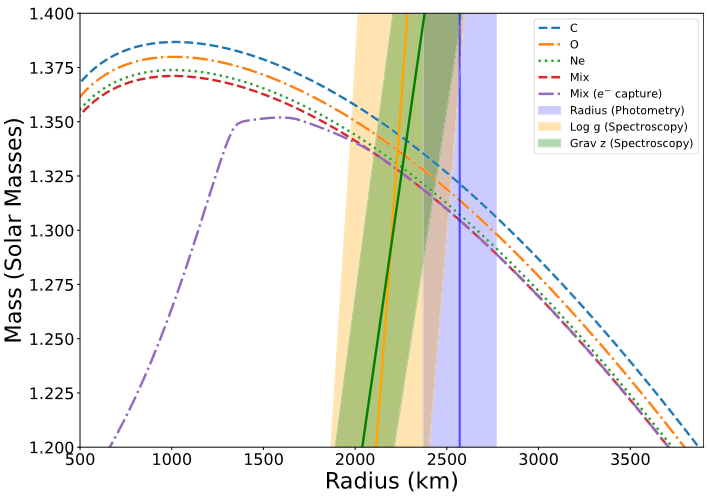
We recently discovered an ultramassive white dwarf that escaped from the nearby Hyades cluster (2023ApJ…956L..41M). It is one of only three white dwarfs with a mass likely greater than 1.3 solar masses, but unlike the other two, it is not strongly magnetic, so we can use spectroscopy to estimate its mass as well, yielding a test of the mass-radius relation for white dwarfs!

Hello Janus

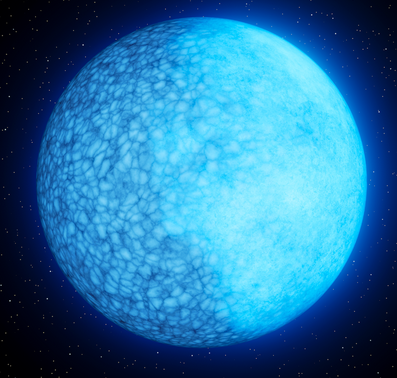
As reported in Nature (2023Natur.620…61C), the ZTF survey discovered a rapidly rotating white dwarf (ZTF J203349.8+322901.1 or Janus) that follow-up spectroscopy reveal is half-covered with helium and the other half-covered with hydrogen, a white dwarf with two faces!

IXPE Measures Polarized X-Rays from a Magnetar

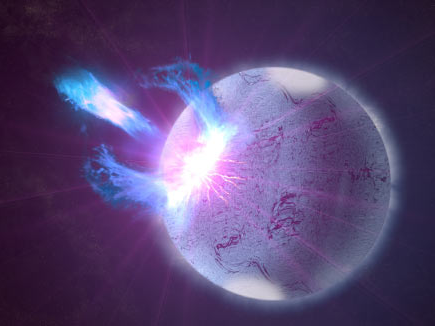
IXPE finally measures the long-predicted polarization of X-rays from the surface and magnetosphere of a magnetar (4U 0142+61) as published in Science, 2022Sci…378..646T. The extent of polarization from 2-4 keV is about ten percent indicating the surface is likely to be solid or liquid. Above 4 keV, the mode of polarization switches and increases to about 30% as expected from resonant Compton scattering in the magnetosphere. This is an amazing validation and probe of the magnetar model!

Understanding the most massive white dwarfs

We have completed a comprehensive study of massive white dwarfs with Gaia EDR3 10.1093/mnras/stac458. We can account for the numbers of white dwarfs between 0.95 and 1.15 solar masses with white dwarf cooling models and the rate of star formation in the Galaxy over the past few billion years. In fact, these massive white dwarfs provide an excellent method to trace star formation. The most massive and rare white dwarfs with masses greater than 1.15 solar masses appear to be form through a combination of mergers and the evolution of single stars with about equal numbers forming through these two avenues over the past few billion years.

Reuniting Clusters with Gaia EDR3

We developed a novel method to reconstruct and determine the ages of all the young clusters within 200 pc of the Sun using Gaia EDR3 including the Pleiades 10.3847/1538-4357/ac45fc and four other clusters 2110.04296. In the process we found two white dwarfs lost from the Pleiades bringing the total number of Pleiad WDs to three and three from the Alpha Persei cluster 10.3847/2041-8213/ac50a5. These are the most massive white dwarfs to have been associated with clusters using the unprecedentedly precise astrometry of Gaia.

The Smallest White Dwarf

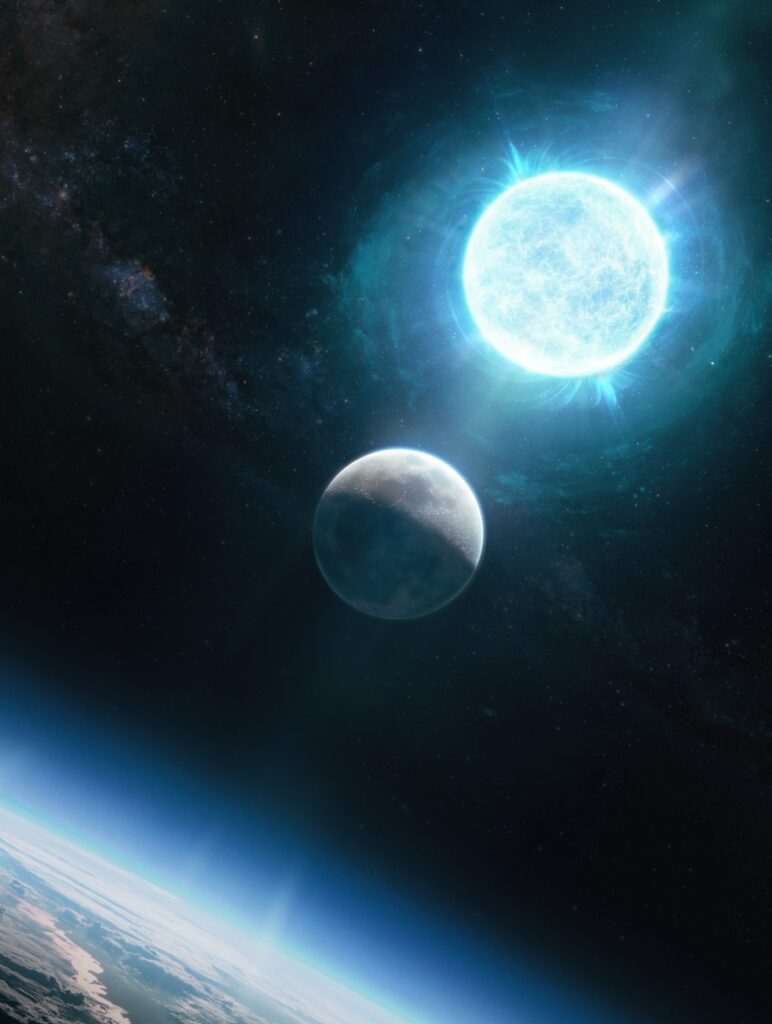
This illustration shows the white dwarf ZTF J190132.9+145808.7 and the Moon. Image credit: Giuseppe Parisi.

Alumna Ilaria Caiazzo led a team based at Caltech and elsewhere to discover the smallest and therefore most massive white dwarf ever found. It is within about one percent of the maximum mass that a white dwarf can be, the Chandrasekhar mass. It rotates every seven minutes and harbours a magnetic field more than a billion times stronger than Earth’s 10.1038/s41586-021-03615-y.