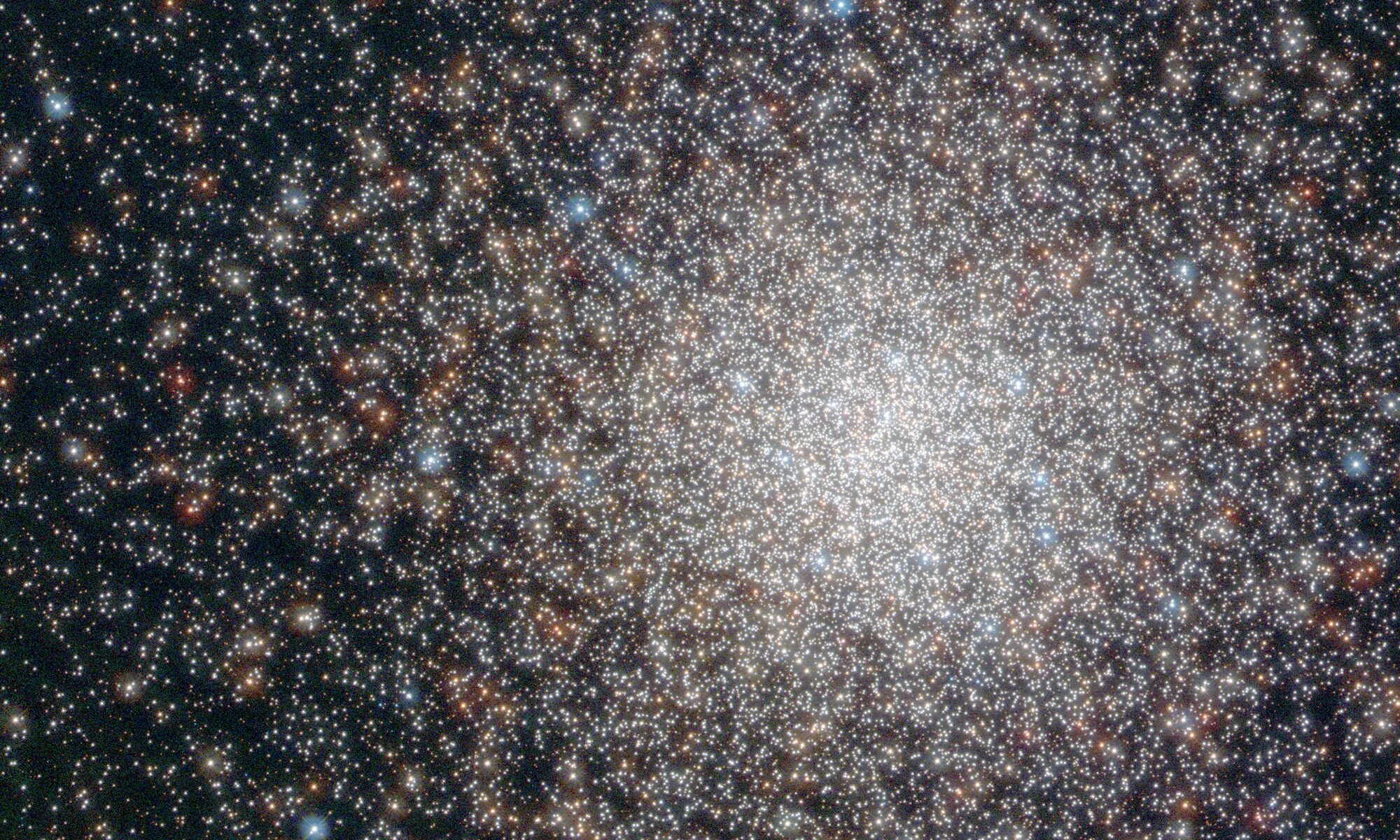
Chasing Dark Matter in an Ancient Star Cluster: New Limits on Axions from White Dwarf Cooling in 47 Tucanae
Can Dying Stars Reveal New Fundamental Particles?
Astronomers often use telescopes to study stars, galaxies, and black holes. But sometimes the most profound discoveries emerge not from what we see, but from what appears to be missing.
In our latest study, we used some of the oldest stars in the Milky Way to search for evidence of one of the most elusive hypothetical particles in physics: the axion. These particles were originally proposed to solve a problem in particle physics, but they have since become one of the leading candidates for dark matter. Despite decades of experimental effort, axions have never been detected directly. Instead, researchers continue to look for their subtle fingerprints in astrophysical environments.
One promising place to search is inside white dwarfs, the dense stellar remnants left behind when Sun-like stars exhaust their nuclear fuel. If axions exist and interact with electrons, they could be produced in the ultra-dense interiors of white dwarfs and carry energy away from the star. This extra energy loss would cause white dwarfs to cool more rapidly than standard theories predict.
Why 47 Tucanae?
Our study focuses on 47 Tucanae, one of the most massive and best-studied globular clusters in the Milky Way. Located roughly 15,000 light-years away, 47 Tuc contains hundreds of thousands of stars that formed at nearly the same time and from the same material.
This makes it a nearly ideal laboratory for studying stellar evolution. Unlike stars in the Galactic disk, whose ages and histories vary widely, stars in a globular cluster provide a clean population whose properties can be modeled with much greater confidence.
The cluster also hosts a rich population of white dwarfs whose cooling histories are encoded in high-quality observations obtained with the Hubble Space Telescope.
Using White Dwarfs as Particle Detectors
White dwarfs cool in a predictable way over billions of years. The physics governing this process is generally well understood, making white dwarfs excellent cosmic laboratories.
If axions are produced inside a white dwarf, they would escape almost immediately, carrying energy away with them. This would alter the cooling rate, leaving a detectable signature in the distribution of white dwarfs observed in a cluster.
To search for this effect, we developed a large suite of stellar evolution models using the MESA stellar evolution code. These simulations included the standard cooling processes expected for white dwarfs as well as additional energy loss caused by hypothetical axion emission. We explored a wide range of white dwarf masses, envelope thicknesses, and axion coupling strengths.
The theoretical predictions were then compared directly with Hubble observations of white dwarfs in 47 Tucanae using a modern unbinned likelihood analysis, allowing us to extract as much information as possible from the data.
What Did We Find?
The result was both exciting and somewhat disappointing, depending on your perspective.
The best-fitting model turned out to be the simplest one: a model with no observable axion emission at all.
Rather than finding evidence for axions, the observations allowed us to place one of the strongest astrophysical constraints yet on how strongly axions can interact with electrons.
We find:
at the 95% confidence level.
This limit improves upon previous constraints derived from white dwarf cooling studies and significantly restricts the range of axion properties suggested by earlier reports of anomalous white dwarf cooling in the Galactic disk and halo.
A Challenge for Earlier Axion Hints
Several previous studies had reported intriguing indications that white dwarfs might be cooling slightly faster than expected. These anomalies could potentially be explained by axions with electron couplings in the range of roughly
Our new analysis excludes much of that parameter space.
While this does not rule out axions entirely, it does make it increasingly difficult to reconcile all of the astrophysical evidence with the particular axion interpretation suggested by earlier white dwarf observations.
Why This Matters
One of the remarkable aspects of modern astrophysics is that ancient stars can act as precision laboratories for fundamental physics.
The white dwarfs in 47 Tucanae formed from stars that have been evolving for more than ten billion years. Today, they allow us to test ideas that extend far beyond astronomy, including possible solutions to mysteries in particle physics and dark matter.
Even a null result can be valuable. By showing what the data do not support, we narrow the possible properties of new particles and help guide future laboratory experiments and astronomical searches.
As observational capabilities continue to improve, especially with upcoming facilities and increasingly sophisticated stellar models, globular clusters such as 47 Tucanae will remain among our most powerful tools in the search for new physics.
Paper Information
Title: Axion constraints from white dwarf cooling in 47 Tucanae
Authors: Leesa Fleury, Alysa Obertas, Harvey Richer, and Jeremy Heyl
Journal: Journal of Cosmology and Astroparticle Physics 10 (2026) 045
DOI: https://doi.org/10.1088/1475-7516/2026/10/045
arXiv: https://arxiv.org/abs/2511.21676
This study combines stellar evolution theory, Hubble Space Telescope observations, and modern statistical methods to place some of the strongest white-dwarf-based constraints yet on axion-electron interactions.